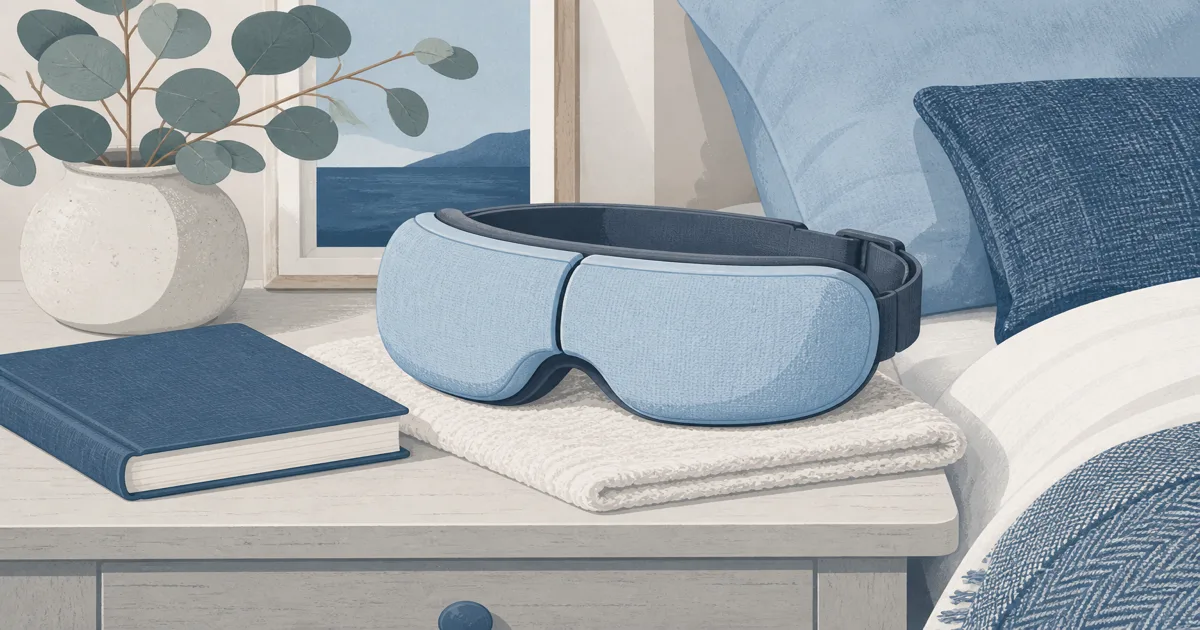
Best Eye Massager (2026): Heat, Fit, and Noise
Accessories
The RENPHO Eyeris 1 is the best eye massager for most buyers who want adjustable heat and air pressure without a bulky setup. Here is what the heat, pressure, and motor noise actually feel like, what a session costs to run, and when a plain warm compress is the better buy.
Our picks
The best eye massager for most people is the RENPHO Eyeris 1 Eye Massager with Heat. It pairs adjustable warmth with gentle air pressure, folds flat for storage, and has enough owner history that you can read how the fit lands on faces like yours before you buy.
An eye massager is a comfort device for tired eyes and tight temples. It will not fix an eye condition, and it is not a substitute for care when something hurts in a new way. The useful questions are simpler. Does the mask sit without poking you in the nose? Can you turn the pressure down? Does the heat feel pleasant rather than swampy? And can you stand the sound of the pump while you relax?
Answer those four and you know whether one belongs in your routine. The sections below cover what the heat and pressure actually feel like, how loud the pump really is, what an evening habit costs to run, and how to avoid the fit problems that send these masks back to the store.
If you want heat without a motor or vibration, the heated eye mask guide is the better lane. For a cool-down in the morning, see the face ice roller. If the tension sits in your neck rather than your eyes, start with the neck massager picks. All of it lives in the recovery accessories lane alongside our massage gun picks.
Is the RENPHO Eyeris 1 the best eye massager for most people?
Yes, for most buyers it is. Heat and air pressure are both adjustable, the shell folds flat, and it has the deepest owner trail in the category, so you can check how the fit lands on faces like yours before you order.
RENPHO Eyeris 1 Eye Massager with Heat
The RENPHO Eyeris 1 is the pick because it gets the basics right. Warmth lands in about a minute and tops out around 104 degrees, which is comfortable rather than intense. Five modes mix air pressure, vibration, and heat, so you can run warmth alone on a sensitive evening or add the pressure after a long screen day.
The compression targets the temples and the bones around the eye socket, inflating and deflating in waves instead of holding one static squeeze. That rhythm is the part people either love or find too much, and the lowest setting is there for the second group. The shell folds flat, and it charges over USB, so it lives in a nightstand drawer rather than on a shelf.
Because it has been on the market for years, there is plenty of owner feedback about fit. Faces are not symmetrical, and some buyers find the cushions land more on the temples than around the eyes. That is worth reading about before you order, because the return window is easier to use than a mask that never quite sits right.
How loud is an eye massager, really?
About as loud as a quiet conversation. The RENPHO Eyeris 1's air pump runs near 52 decibels, which is audible in a silent room and easy to ignore with any background sound. No powered eye massager is truly silent.
What 52 decibels means in practice
Decibels are logarithmic, so the gap between two numbers is bigger than it looks. A normal conversation sits around 60 decibels. The Eyeris 1 at about 52 decibels is 8 decibels below that, which works out to roughly 6.3 times less acoustic power (10 raised to the power of 8 divided by 10). In plain terms, the pump is a soft mechanical hum, not a drone.
What that means for your evening is simple. If you use the mask in a quiet bedroom with nothing else on, you will hear the pump cycle as the cushions inflate and release. If a fan, a white-noise app, or a TV is running, it disappears. The built-in Bluetooth speakers are fine for a podcast, but they do not cover the pump, so do not buy this expecting to listen to something quiet and still hear it clearly.
If silence is a hard requirement, a passive warm compress is the answer. A microwavable heated eye mask has no pump and no motor, and it costs a fraction of a powered mask.
How long should an eye massager session be?
Start with the shortest cycle the mask offers, usually 10 to 15 minutes, and stop there. That is long enough to feel the heat and decide whether the pressure suits you. Longer is not better.
The 10 to 15 minute window
The timer on these masks exists so you do not have to guess, and the shortest program is the right starting point. Ten minutes of gentle warmth and light pressure is a wind-down. Thirty minutes of the same is a chore, and the novelty wears off fast if the routine feels long.
Two habits make the mask easier to keep using. First, run heat alone for the first few sessions so you can judge the warmth without the pressure. Second, set it going before you are already exhausted, because a device you have to talk yourself into wearing becomes a drawer resident within a week.
Fit decides whether it survives week two
Fit is the reason most of these masks get returned. The cushions are one size on many models, and a narrow face can leave them sitting on the temples instead of around the eyes. If you are between sizes or wear glasses, lean toward a model with more adjustability and a generous return policy, and check the recent reviews for how the straps and liners hold up over months rather than days.
What does an eye massager cost to run?
Almost nothing per session. At about $60, the mask works out to roughly 20 cents a use across 300 evening sessions a year, and the electricity is a rounding error. The purchase price, not the power, is the real cost.
Run the numbers for the mask itself and it is one of the cheaper recovery gadgets you can own. A $59.99 device used five nights a week for a year is about 23 cents a session, and it uses a USB charge rather than a wall draw. The number to weigh is not the power bill, it is whether you will actually wear it, because an unused mask costs the full price every time.
Do eye massagers help with headaches and dry eyes?
For tension headaches that start with eye strain, a warm session with gentle pressure can take the edge off. For dry eyes, warmth is the piece that fits a typical routine, though a powered massager is not a treatment for a diagnosed condition.
Tension headaches
The heat relaxes the muscles around the eyes and temples, and the dark, closed-eye time helps on its own. Many people find that the calm ten minutes does as much as the device. What an eye massager cannot do is fix a migraine that comes with aura, nausea, or light sensitivity. If pain is new, severe, or changing, skip the mask and talk to a clinician.
Dry eyes
Warm compresses are already a common part of dry-eye care, so the warmth is the feature that fits. Some people find the gentle pressure soothing on tired, dry-feeling eyes. A powered massager is not a treatment for dry eye, and anyone with a diagnosed condition should follow their eye doctor's plan rather than swapping it for a gadget.
Eye massager versus heated eye mask versus ice roller
These three tools solve different problems, and most people only need one. A powered eye massager adds pressure and vibration to warmth, which makes it the most active of the three and the best fit for tired, strained eyes at night.
A heated eye mask is passive warmth, often from a microwave. It is cheaper, silent, and simpler, and it suits dry-eye routines and people who want heat with nothing moving on their face. If you mostly want warmth, start there.
A face ice roller goes the other direction and handles morning puffiness better than heat does. Some people keep both, using the roller in the morning and the massager at night. That is a reasonable split, as long as you are not buying all three at once.
Who an eye massager is not for
Skip a powered eye massager if you dislike anything touching your face. No amount of heat compensates for a device you have to talk yourself into wearing, and a warm compress or a cool cloth gets you most of the way for a fraction of the price.
Skip it after eye surgery, with an active eye infection, or if the instructions list your condition as unsuitable. Do not use one with contacts in, and stop immediately if you feel burning, numbness, or new irritation.
Also skip it if you need silence to relax. The pump is audible on every model in this category, and the Eyeris 1 sits around the volume of a quiet conversation. If that would bother you, a microwavable mask is the honest choice.
Buying details that prevent returns
Confirm how it charges. Most of these masks use USB, but cable type and charging time vary, and a proprietary cable that goes missing is a dead device. Check whether the remote is required for basic functions or whether the buttons are on the mask itself.
Read the recent critical reviews for the things that show up over months, not days. Straps that loosen, liners that crack where they fold, and uneven heat are the usual wear complaints, and they predict ownership better than a feature list.
Measure before you buy if fit worries you. Some masks are one size, and a narrow face can leave the cushions sitting on the temples instead of around the eyes. If you are between sizes or wear glasses, lean toward a model with more adjustability and a generous return policy.
The bottom line
The RENPHO Eyeris 1 Eye Massager with Heat is the best eye massager for most home buyers who want adjustable warmth and air pressure in a mask that stores easily. Start on the lowest pressure, keep sessions to 10 to 15 minutes, and treat it as evening comfort rather than medical treatment. At about 20 cents a session it is cheap to own, and the pump noise is the only thing to audition before you commit.
If you would rather have silent, simple heat, the heated eye mask is the better buy. Browse the rest of the recovery accessories picks, or start with the blog for the full home recovery stack.
Frequently Asked Questions
What is the top rated eye massager?
The RENPHO Eyeris 1 is the top rated eye massager for most home buyers, with heat and air pressure you can turn down and a foldable design that stores easily. If you want no motor and no vibration at all, a microwavable heated eye mask is the better lane.
Do eye massagers really work?
They work as comfort devices. The warmth and gentle pressure around the eyes and temples help tired, strained eyes feel looser at the end of a screen-heavy day. They do not treat eye disease, fix vision, or replace medical care, and anyone expecting a clinical result will be disappointed.
Can an eye massager improve eyesight?
No. Nothing about squeezing the tissue around your eyes changes how the eye focuses. Blurry vision right after a session is temporary and comes from the pressure on the eyeballs. If your vision stays blurry or changes, see an eye doctor rather than reaching for the mask again.
What is the best device for reducing puffy eyes?
For puffiness, cold usually does more than heat. A chilled ice roller for the face in the morning tends to beat a heated mask for that specific job. A heated eye massager is better suited to tired, achy eyes at night than to morning puffiness.
Are eye massagers loud?
Most powered eye massagers are audible, because an air pump inflates and deflates the cushions. The RENPHO Eyeris 1 measures around 52 decibels, about the level of a normal conversation. The Bluetooth speakers do not hide it. If you need silence, a passive warm compress is the quieter choice.
How long should a session last?
Start with the shortest cycle the mask offers, which is usually around 10 to 15 minutes. That is enough to decide whether the heat and pressure suit you. Longer is not better, and the built-in timer exists so you do not have to guess.
Do eye massagers help dry eyes?
Some people find the warmth and gentle pressure soothing on tired, dry-feeling eyes, and warm compresses are a common part of a dry-eye routine. A powered massager is not a treatment for dry eye, though, and anyone with a diagnosed condition should follow their eye doctor's plan first.
Can I wear an eye massager over glasses?
No. Take glasses off before you put the mask on. If you wear contacts, check the listing and consider removing them for the session, since pressure on a contact lens is uncomfortable and most people prefer to run it with contacts out.