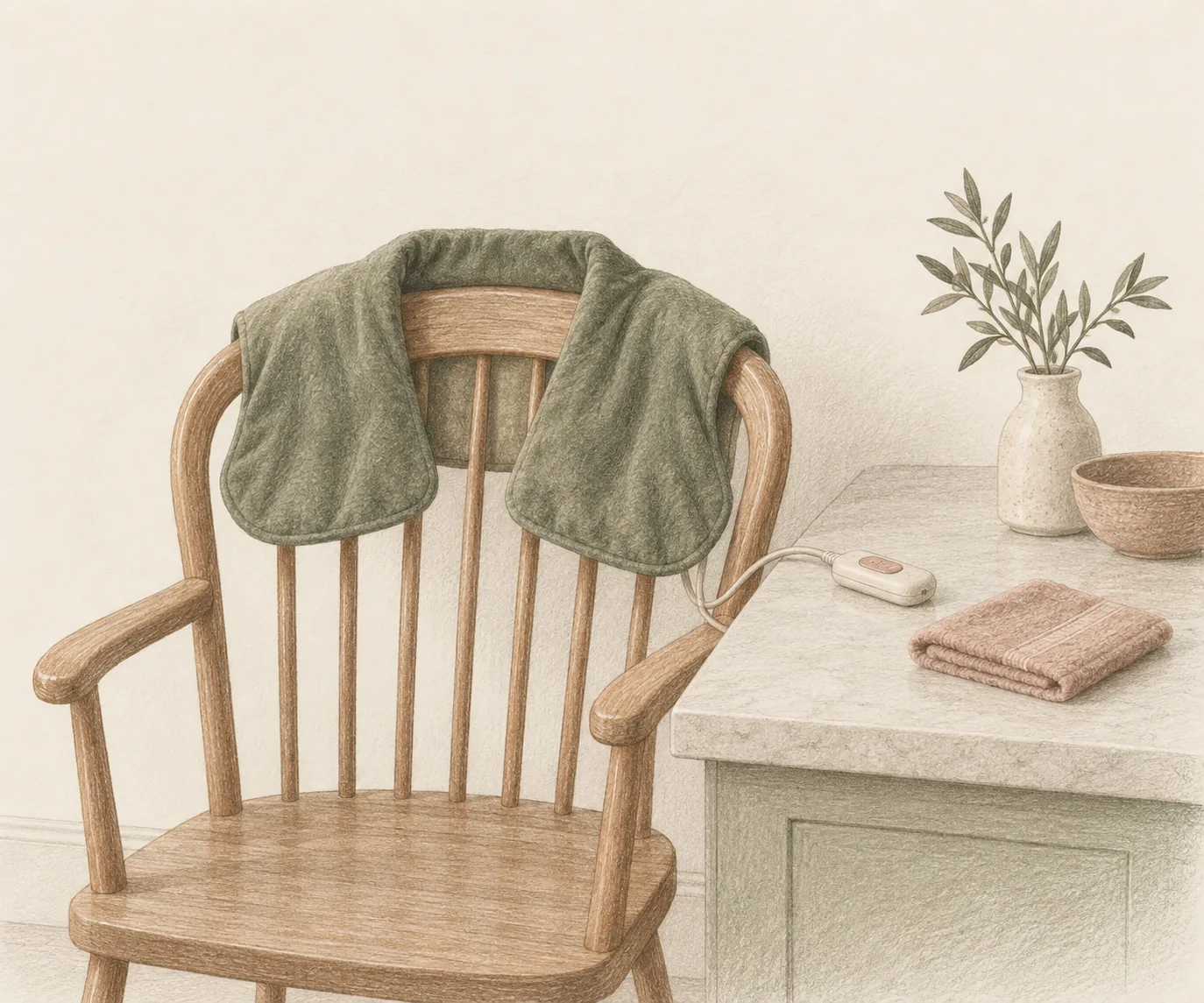
Heating Pad for Neck Pain (2026): 3 Picks That Stay Put
Accessories
The best heating pad for neck pain is a weighted wrap that drapes over the neck and both shoulders instead of a flat rectangle you have to hold in place. The Lenmen 22 x 18 wrap is our pick, the TATOWN 17 x 33 covers more, and the Carex Bed Buddy is the cordless microwave option.
Our picks
The best heating pad for neck pain is the Lenmen Graphene-Infused Weighted Heating Pad. It is a 22 by 18 inch wrap with weighted edges, so it settles onto your shoulders and stays there while you sit, instead of sliding off the moment you move. Heat arrives in about a minute and you can dial it across six levels, which matters because a stiff neck wants gentle warmth for a while, not one blast.
A heating pad is comfort care for muscle tightness. It will not fix a disc, a pinched nerve, or a headache that comes with nausea, and it is not a substitute for care when something feels new or sharp. The useful questions are simpler. Does the pad stay on your neck without you holding it? Can you turn the heat down? Does it reach the spots that actually hurt, which for most people is the neck plus the tops of both shoulders?
Answer those three and you know which shape to buy. The sections below cover the wrap versus flat-pad tradeoff, the session timing that clinical guidance actually supports, what each pick costs to run, and when ice is the better call.
If your pain sits in the lower back instead, start with the best heating pad for back pain. If you want the general roundup of pads for every body part, see best heating pads, and the best neck heating pad guide covers wrap fit in more detail. All of it lives in the recovery accessories lane, which starts with the massage gun picks for portable relief.
Which heating pad shape works best for neck pain?
A weighted wrap beats a flat pad for the neck, because it drapes over the shoulders and stays in place without your hands. A flat 17 x 33 pad covers more skin and is better when the ache spreads into the upper back.
Weighted wrap versus flat XL pad
The neck is an awkward shape to heat. A rectangle laid across the back of your neck leaves the sides and the tops of the shoulders cold, and it slides the moment you lean back. That is why the better neck pads are cut and weighted like a collar. The Lenmen wrap uses keep-warm ceramic beads along its edges, so the fabric falls over the shoulders and holds its position while you sit at a desk or on a couch.
The flat pad solves a different problem. If your pain runs from the neck into the trapezius and upper back, a big rectangle is the only way to cover all of it at once. You trade hands-free fit for reach, and you accept that you will reposition it.
Coverage in square inches
The numbers are the honest way to choose. The Lenmen wrap covers 396 square inches, which is 29% more pad than the 14 by 22 inch shape (308 square inches) that most brands sell for the same neck job. The TATOWN covers 561 square inches, 42% more than the Lenmen, which is exactly why it is the pick when the upper back is involved.
How hot and how long should a neck session be?
Use heat for 15 to 20 minutes at a time, wrapped in a thin towel if the setting feels sharp, and let your skin return to its normal color before you reapply. Warm and comfortable beats hot every time.
The 15 to 20 minute rule
This is the number most people get wrong. Longer is not stronger. Clinical guidance from WebMD and Cedars-Sinai lands on 10 to 30 minutes, with 15 to 20 as the practical window, and a break of at least 40 minutes before the next round. Skin that looks purplish-red or blotchy afterward means the temperature was too high, not that the pad worked well.
Start on the lowest setting every time. A neck that has been stiff for days does not need the top level on the first session, and the pads here default to a warm rather than scalding top end for that reason.
What the clinical evidence says
The research is modest but real. A randomized trial of a heat pad used 20 minutes a day for 14 days in people with chronic mechanical neck pain improved both pain scores and somatosensory function. A separate systematic review on heat for non-specific neck pain notes that a 1 degree Celsius rise in tissue temperature lifts local metabolism by 10 to 15%, and that a heat source held at about 41 degrees Celsius raised the pressure-pain threshold from 25.15 N to 34.59 N in the same study population.
The ordering also matters. Mayo Clinic guidance is cold for the first 48 hours after a strain, then heat, and it notes most mild to moderate neck pain improves within 2 to 3 weeks with simple self-care. If yours has not, that is a reason to get it looked at rather than to raise the heat.
The best heating pads for neck pain
Lenmen Graphene-Infused Weighted Heating Pad, 22 x 18
The Lenmen Graphene-Infused Weighted Heating Pad is our top pick because the shape is built for the job. The 22 by 18 inch surface is cut to sit around the neck and over both shoulders, the edges carry keep-warm ceramic beads for weight, and the wiring runs both vertically and horizontally so the fabric conforms instead of standing up like cardboard.
You get six heat levels from 108 to 144 degrees and four auto-off timers from 30 minutes to 2 hours. That range is the point. A gentle 108 degree setting for 20 minutes is a different tool from a 144 degree blast, and having both means you can find the one your neck tolerates. The pad is machine washable once you detach the controller.
Choose Lenmen if: you want hands-free heat on the neck and shoulders and you will use it while sitting. Skip Lenmen if: the ache runs deep into your upper back, or you need to be away from an outlet.
TATOWN 17 x 33 Heating Pad
The TATOWN 17 x 33 Heating Pad is the coverage pick. It is a double-sided velvet pad with three heating elements, six heat levels from about 104 to 140 degrees, and four timers from 30 to 120 minutes. The 7-foot cord is long enough for a couch or a bed, and it can be used as moist heat if you mist the surface lightly.
This is the pad to choose when your neck pain is really a neck-and-upper-back problem. It is also the one to choose if you like to lie down with heat rather than sit. What it will not do is stay shaped around your neck while you work at a desk, because there is nothing holding it there.
Choose TATOWN if: you want maximum coverage and a fast warm-up. Skip TATOWN if: you need hands-free fit or a wrap that follows the neck.
Carex Bed Buddy Heat Pad and Cooling Neck Wrap
The Carex Bed Buddy Heat Pad and Cooling Neck Wrap is the cheapest way into heat therapy and the most flexible. It uses no electricity at all, which means no cord, no outlet, and no controller to misplace. Fill it with natural grains, heat it in the microwave, and it produces moist heat that most people find more penetrating than dry electric warmth.
At $8.47 it costs about 2 cents a day if you use it every day for a year, which makes it the low-risk way to find out whether heat helps your neck before you spend on a powered pad. Wipe it clean with a damp cloth only, and never machine wash or submerge it.
Choose Bed Buddy if: you want cordless, cheap, and moist heat, or you want to test heat therapy first. Skip Bed Buddy if: you want a long, uninterrupted session at a steady temperature.
What does a heating pad cost to run?
Almost nothing. A corded pad on a 20-minute session draws about 0.0183 kWh, which is roughly a third of a cent at a typical US rate, and a microwave wrap reheated per the instructions costs about half a cent. The purchase price matters far more than the electricity.
Electricity versus microwave arithmetic
The real running cost is the pad itself. At $35.99 the Lenmen wrap works out to about 12 cents a session if you use it 300 times, and at $8.47 the Bed Buddy is under 3 cents a session. Neither number should drive the decision, which is why the shape and the fit are the only things worth arguing about.
Heating pad versus microwave wrap versus ice
Heat and cold do different jobs, and the choice is about timing rather than preference. Heat relaxes muscle and eases stiffness. Cold calms fresh swelling and numbs a sharp spot.
When heat is the wrong call
Use ice, not heat, for the first 48 hours after a strain or a tweak, because heat on fresh swelling can make it feel worse. Use heat once the acute phase has passed and the complaint is stiffness and tight muscle. If you are not sure which stage you are in, cold is the safer first move for a new injury.
Skip heat entirely if a clinician has told you to avoid it, if the area is numb, or if you have a skin condition in the treatment area. And do not stack heat with a topical pain product unless the label says it is fine, because some of them warn specifically against combining the two.
Heat plus a stretch beats heat alone
The most useful thing you can do after a session is move gently. Mayo Clinic guidance suggests warming the neck with heat or a warm shower before slow neck and shoulder rolls, which is the sequence most physical therapists use. Heat first, then easy movement, then back to your day.
If kneading rather than warmth is what your neck wants, the best neck massagers guide is the better lane. For a passive stretch tool that works the other direction, see the best neck stretcher.
Who should skip a heating pad for neck pain?
Skip a heating pad if your pain came with a sudden severe headache, tingling or numbness in the arm or hand, weakness, or pain after a fall. Those are reasons to get medical advice, not to add warmth. Heat is for ordinary stiffness, and it is not a treatment for a nerve problem.
Also skip a corded pad if you know you will fall asleep with it on, if you cannot feel temperature normally in the area, or if the pad has a damaged cord. A microwave wrap is the safer option in those cases because it cools down on its own and has no live current.
The bottom line
The best heating pad for neck pain is the Lenmen Graphene-Infused Weighted Heating Pad, because the weighted 22 by 18 inch wrap stays on your neck and shoulders while you sit and gives you six levels from 108 to 144 degrees. Choose the TATOWN 17 x 33 when the ache spreads into your upper back and you want 561 square inches of coverage, and the Carex Bed Buddy when you want a cordless, under-ten-dollar wrap that works hot or cold.
Whatever you pick, keep sessions to 15 to 20 minutes, start on the lowest setting, and use ice instead of heat for the first 48 hours after a fresh strain. Browse the rest of the recovery accessories picks, or start with the blog for the full home recovery stack.
Frequently Asked Questions
What is the best heating pad for neck pain?
A weighted wrap that drapes over the neck and both shoulders is the best heating pad for neck pain for most people. The Lenmen Graphene-Infused Weighted Heating Pad is our pick because it stays put without hands. A flat 17 x 33 pad is the better choice if the pain spreads into the upper back.
Are heating pads good for neck pain?
Yes, for ordinary muscle tightness. Heat relaxes muscle, improves blood flow, and eases stiffness, and a randomized trial that used a heat pad for 20 minutes a day over 14 days found real pain relief in chronic mechanical neck pain. Heat is comfort care, not a cure, and it does not treat a pinched nerve.
How long should I use a heating pad on my neck?
Use it for 15 to 20 minutes at a time, then let your skin return to its normal color before you apply heat again. Wrap the pad in a thin towel if the setting feels sharp, and never fall asleep with a corded pad running.
Should I use heat or ice on my neck?
Ice first for a fresh injury, then heat. Mayo Clinic guidance is cold for the first 48 hours to calm swelling, and heat after that to relax the muscles. For a stiff neck that built up over days at a desk, start with heat.
How hot should a neck heating pad be?
Warm and comfortable, not sharp. Most pads top out between 104 and 144 degrees, and the useful range for a long session is the low to middle setting. If the skin looks blotchy or feels numb, the setting is too high.
Can I use a heating pad while I sleep?
No. Use the timer, stay awake, and keep the controller within reach. Auto shut-off exists because heat plus sleep is how people get burned, and numb skin cannot tell you the pad is too hot.
What is the best heating pad for neck and shoulders?
Look for a wrap that covers the neck and both shoulders in one piece, not a narrow strip. The Lenmen wrap covers about 396 square inches, and the TATOWN flat pad covers about 561 square inches if you want the upper back included too.
When should I skip heat and see a clinician?
Skip heat after a fresh injury with swelling, or if a clinician has told you to avoid it. A sudden severe headache, tingling, weakness, or pain that travels down an arm needs medical advice, not more warmth.