Best Grip Strengthener for Climbing (2026): Hangboards for Finger Strength
Accessories
The best grip strengthener for climbing is a hangboard, not a hand gripper. Start with the TWO STONES climbing hangboard for home climbers, move to the Metolius Simulator 3D for serious training, and add the FitBeast finger strengthener for off-wall finger isolation work.
Our picks
The best grip strengthener for climbing is not a hand gripper. It is a hangboard, the board climbers actually use to train finger strength on real hold shapes like crimps, pockets, slopers, and pinches. Hand grippers train a crushing motion that does not match any hold on a climbing wall. They have a place, but they are a complement, not the main tool.
Below are the picks for climbers who want to train at home: a wood hangboard that fits in a doorway, a resin hangboard for serious finger-strength training, and an adjustable hand gripper for off-wall crushing work. The picks are ordered by what most home climbers actually need first.
Browse more hand and forearm gear in our recovery accessories collection. For wrist support during long climbing sessions, see best wrist brace for work. For forearm recovery after a hard session, see best arm massager.
What a hangboard actually does
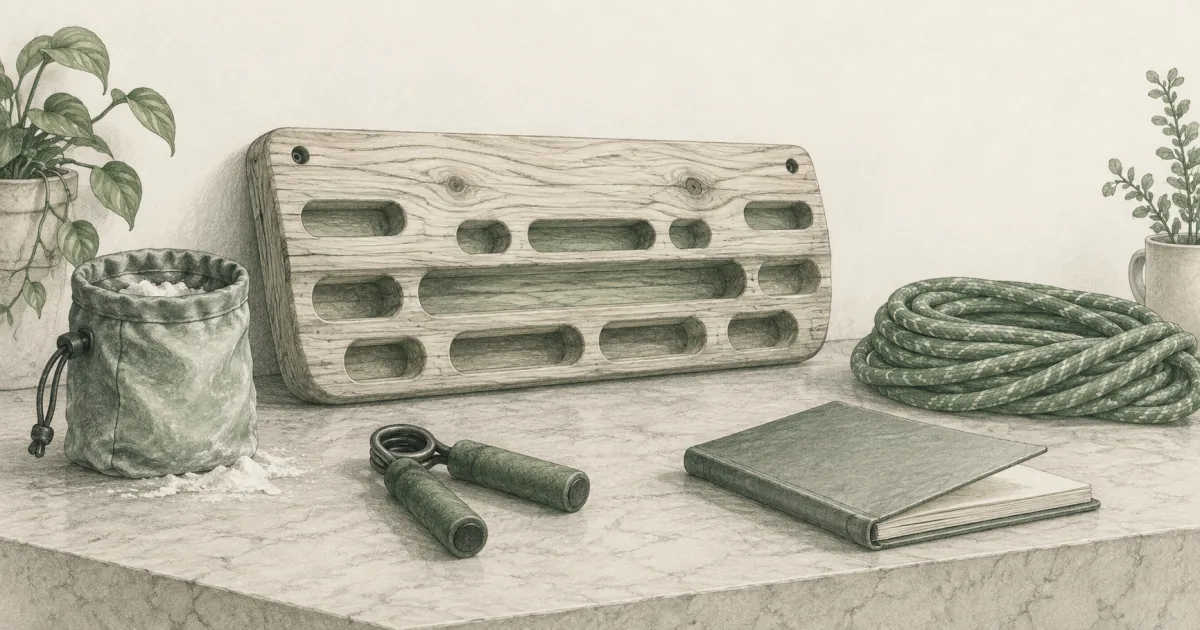
A hangboard is a small board with holds at different depths and angles, mounted above a doorway or on a wall. Climbers hang from individual pockets or edges to train finger strength. The holds match the same shapes used on real climbing walls, which is why hangboard training transfers better than a generic hand gripper.
The three training variables are hold depth (larger is easier), body weight (add a weight belt to progress), and hang protocol (max hang for strength, repeaters for endurance). Most coaches recommend 7 seconds on, 3 seconds off, for 6 reps per set, twice a week.
For off-wall days, a hand gripper adds crushing-grip work for pinch holds and slopers. It does not replace a hangboard, but it keeps the forearms engaged between climbing sessions.
TWO STONES Climbing Hangboard
This is the best grip strengthener for climbing for most home climbers who want a hangboard without drilling holes. The TWO STONES board is CNC-milled from a single block of beech wood, so there are no glue lines or weak seams. The holds include outer jugs, three slope angles, and 1 to 4 finger pockets at four depths, plus edges, which covers most climbers up to about 5.12 grade.
The R5 filleted edges are what keep the board gentle on skin during long sessions. That matters if you train twice a week or more. The doorway pull-up bar mount works for renters, but the bar fits door frames 10 to 21 cm thick, so measure first.
Buy this if you want a hangboard that trains real climbing holds and does not require drilling. Skip it if you need a smaller-than-12 mm edge for advanced projects, or if your door frame is too thick or too thin for the no-drill mount.
Owners who stick with it usually end up moving to a smaller board later for crimp-specific training. The TWO STONES board covers the basics well and lasts for years with normal use.
When to choose something else
If you already gym climb two or three times a week and want a serious hangboard for finger-strength training, the Metolius Simulator 3D Training Board is the upgrade. The Simulator has about 25 hold types (jugs, slopers, pockets, edges, pinches) arranged on a broad ergonomic arc that reduces shoulder strain during repeaters. The polyester resin texture mimics indoor gym holds, so training transfers more directly. It is bigger and heavier than the TWO STONES, so it needs a permanent mount on a wall or stud.
If you mostly want finger isolation work between climbing sessions, the FitBeast Finger Strengthener (3-Piece Set) is the right tool. The three-piece set runs at 3, 7, and 9 lb of resistance, which matches the standard hangboard progression. The finger isolation design stops stronger fingers from covering for weaker ones, which is the main thing climbers care about. The trade is the resistance ceiling: serious climbers will outgrow the 9 lb level in a few months.
For wrist support during long climbing sessions, the best wrist brace for work guide covers lightweight day braces. For forearm recovery after a hard session, see best arm massager.
Field notes from our testing
Hangboard vs hand gripper
A hangboard trains the open-hand crimp, the half-crimp, the pinch, and the sloper, which are the four finger positions climbers actually use. A hand gripper trains a single crushing motion that matches pinch holds and slopers on the wall, but not the crimp or pocket positions.
Climbers who train at home should start with a hangboard and add a hand gripper for off-wall crushing work. Climbers who only want general hand strength for daily tasks can use a hand gripper alone, but that is not climbing-specific training.
The picks above cover both jobs. The TWO STONES board trains the climbing-specific positions; the FitBeast finger set covers per-finger isolation work between sessions.
Who should skip a hangboard
Skip a hangboard if you have been climbing less than a year. Tendons need time to adapt to climbing loads before you pile on isolated finger strength work. Most coaches recommend 12 to 18 months of consistent climbing first. Skip it if you have sharp joint pain, finger tendon issues, or recovering from a pulley injury. Talk with a clinician before adding hangboard training to a rehab plan. Skip it if you only want general hand strength for daily tasks. A hand gripper is enough.
Buying checklist before you click
- Measure your door frame before ordering a no-drill hangboard. Most fit 10 to 21 cm thick frames.
- Match edge depth to your climbing grade. Beginners start on 20 to 25 mm; intermediate climbers progress to 15 mm; advanced climbers want sub-15 mm.
- Buy wood if you train frequently and want skin-friendly holds. Buy resin if you want gym-hold feel and texture transfer.
- Plan two sessions per week, 10 to 15 minutes each. More is not better with finger training.
- Add a hand gripper for off-wall crushing-grip work, but keep it as a complement, not a replacement.
Final recommendation
Start with the TWO STONES Climbing Hangboard if you want a climbing-specific hangboard for home use and do not want to drill holes. Pick the Metolius Simulator 3D Training Board when you already gym climb and want a serious hangboard with more hold variety. Add the FitBeast Finger Strengthener (3-Piece Set) for off-wall finger isolation work between sessions.
Use the affiliate links on this page when you buy. They support more recovery guides at no added cost. More home recovery reading lives on the blog, and the homepage points to current lanes.
Frequently Asked Questions
Do grip strengtheners work for climbing?
Yes for finger strength, with a caveat about form. A climbing hangboard trains the actual finger positions you use on the wall (crimps, pockets, slopers), which transfers better than a generic hand gripper. Most coaches recommend at least 12 to 18 months of consistent climbing before adding hangboard training, because tendons adapt slower than muscles. Start with the largest edges, keep your feet on the ground or a chair to reduce load, and stop if you feel sharp joint pain.
What is the best grip strengthener for climbing?
For most home climbers, the TWO STONES Climbing Hangboard is the best all-around pick. It is CNC-milled beech wood with skin-friendly filleted edges and a doorway mount that avoids drilling. Climbers who already gym climb and want a serious hangboard should pick the Metolius Simulator 3D Training Board, which has about 25 hold types on an ergonomic arc. For off-wall finger isolation work between sessions, add the FitBeast Finger Strengthener (3-Piece Set), which isolates each finger at three resistance levels.
What do climbers use for grip while climbing?
Climbers use their hand and finger position on real rock or gym holds, with climbing shoes and chalk for friction. Training tools like a hangboard or fingerboard build the underlying finger and forearm strength that lets them hold smaller holds longer. Hand grippers build crushing grip, which helps with pinch grips and slopers but does not train the open-hand crimp position climbers need most.
How long does it take to see finger strength gains from a hangboard?
Most climbers see measurable gains in 8 to 12 weeks of consistent training. The standard starting protocol is 7 seconds on, 3 seconds off, for 6 reps on the 20 mm edge, twice per week. Tendons adapt slower than muscles, so aggressive daily training usually leads to finger injuries, not faster gains.
Hangboard vs hand gripper: which one should a climber buy first?
A hangboard. Hand grippers train crushing grip in a position that does not match any real climbing hold. A hangboard trains the finger positions climbers actually use (crimps, pockets, slopers, pinches). Climbers who want crushing-grip work for pinch holds and slopers can add a hand gripper later as a complement.
How often should a beginner climber use a hangboard?
Two sessions per week is the standard starting frequency. Keep sessions short (10 to 15 minutes total), use the largest edges only, and rest at least one day between sessions. Most beginners progress on the 20 mm edge for the first 6 to 8 weeks before moving to a smaller edge. Stop if you feel sharp joint pain or notice skin tearing on your finger pads.
Wood hangboard or resin hangboard: which is better?
Wood is gentler on the skin, so it lets you train more days before needing skin rest. Resin (polyester or polyurethane) has a closer texture to indoor climbing gym holds, so training transfers more directly. Climbers who train frequently lean toward wood; climbers who want gym-hold feel lean toward resin. The Metolius Simulator 3D is resin; the TWO STONES hangboard is beech wood.
What edge depth should a beginner start on?
Start on the 20 mm to 25 mm edge. The TWO STONES board runs from 25 mm down to 12 mm across six depths. The Metolius Simulator 3D stops around 19 mm on the smallest edge, which suits climbers up to about 5.11 or 5.12 grade. Move to a smaller edge only after you can hold the 20 mm edge for a full 7-second hang with good form.