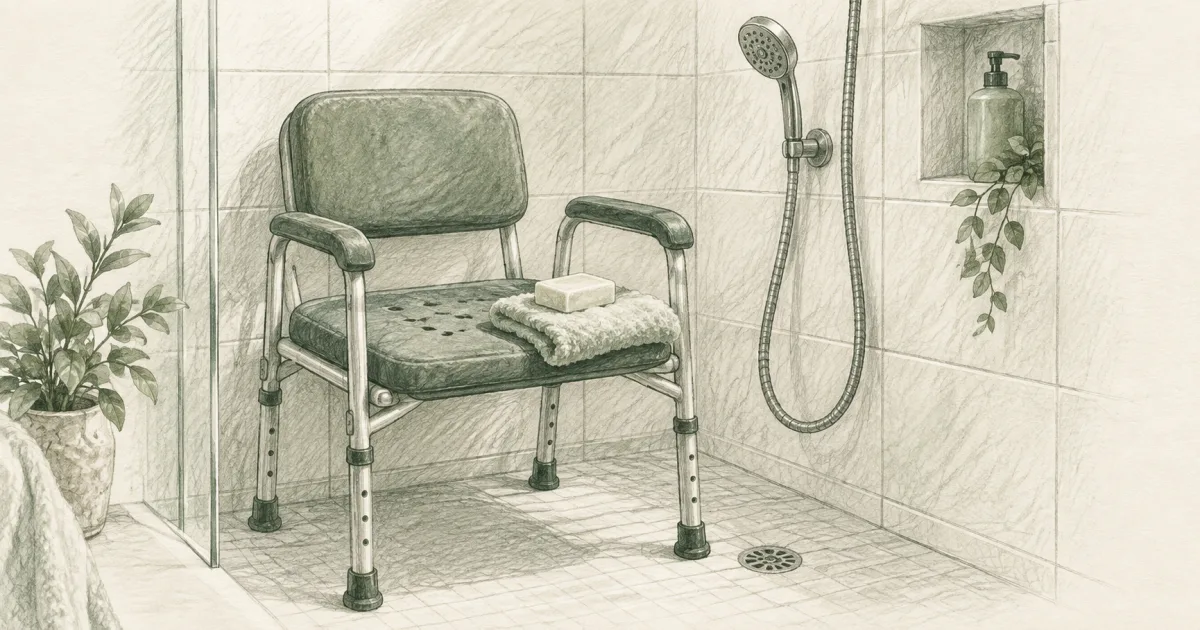
Best Shower Chair for Elderly (2026): Stable Seats With Arms and a Back
Accessories
A shower chair only helps if it does not wobble. The KingPavonini swivel chair is the best default for most older adults, because the seat turns so they can get in and out without standing. The HOMLAND padded chair is the fixed-seat pick, with the Medline seat for value and a compact HOMLAND stool for narrow tubs.
Our picks
The best shower chair for an older adult is the KingPavonini 360° swivel chair for most homes. The seat turns a full circle and locks in place, so the user can sit down facing the wall and then rotate to face the sprayer instead of stepping and twisting on a wet floor. The wide base and padded arms matter more than any feature on the box, because the risk in a shower is a slip during the sit, the turn, or the stand.
The HOMLAND padded chair is the pick if you want a seat that does not move. The Medline seat covers the same job for less, and the HOMLAND compact stool fits small tubs that cannot hold a full chair.
A shower chair looks like a simple purchase. It is really a balance aid. The chair has to stay put on a wet, often sloped floor, and it has to give the user something solid to push against when they stand up. Get those two things right and a daily shower stops being the riskiest part of the day.
That is why the picks below lean on base width, foot grip, arm support, and an easy transfer rather than cup holders or fancy finishes. This gear sits in the recovery accessories lane with the other mobility and sleep tools, starting from the massage gun picks and reaching our inversion table picks and the sacroiliac belt guide.
What to look for in a shower chair for an older adult
Start with the base. A wider stance and larger rubber feet grip better than a narrow, tippy frame. Stainless-steel washers inside the feet keep them from rusting and staining the tub, which is a small detail that decides whether the chair lasts.
After the base, decide whether the seat should turn. A swivel chair lets the user sit down facing the wall, then rotate to face the showerhead or the door without standing and shuffling. That is the safer option for anyone who cannot twist or step carefully, and it is the feature that separates the top pick from the rest. A fixed chair is simpler and often cheaper, and some users who feel unsteady on a moving seat prefer it.
Then look at the arms and back. Arms are the single most useful feature, because they give a push point for standing. A back keeps the user from leaning too far when tired. Both should be padded, so bare skin does not press on a hard edge.
Finally, check the height range and the assembly. The seat should adjust in one-inch steps to match the user, and assembly should not require tools, because a caregiver is often the one setting it up. A chair that takes twenty minutes and a wrench tends to sit in the box.
KingPavonini 360° Swivel Shower Chair
The KingPavonini is the pick for most older adults because of the transfer, not the padding. The seat rides on a bearing and turns a full 360 degrees, locking at each 90-degree stop, so the user can enter facing the wall and rotate to wash without standing. The frame is rated to 550 pounds, the highest here, and it sits on a wider base than a typical bath chair.
The seat is shaped to follow the hips, with a center groove and drain holes that keep water moving, and the back and arms can be removed to turn the chair into a simple stool. Assembly is tool-free, and the removable arms leave a clear path if someone transfers from a wheelchair. The wide armrest span is the tradeoff, so measure the tub before you commit.
Buy it if the user needs help turning or standing in the shower and the tub has room for a wide chair. Skip it if the bathroom is very tight, or if a moving seat would make the user nervous, and step down to the HOMLAND padded chair below.
HOMLAND Shower Chair with Padded Armrests and Back
The HOMLAND padded chair is the pick for anyone who wants a seat that does not move. The frame is rated to 500 pounds with a recommended user weight of 400, and the wide, skid-resistant feet sit flat on tub and shower floors. The arms and back are removable, so it can convert to a simpler stool if the user's needs change.
Assembly is tool-free, and the feet use stainless-steel washers to resist rust stains. The seat adjusts in one-inch steps to fit most bathrooms. Owner reviews repeatedly describe setting it up for a parent after a fall or a stroke and finding it easier to use than a wall handrail.
Buy it if the user wants a fixed, padded seat instead of a swivel, or a moving seat would make them uneasy, and you have room in the tub. Skip it if the shower stall is very narrow, because the wide frame needs clearance. And add a cushion if the firm seat is a concern, since that is the most common owner tweak.
Medline Shower Chair with Backrest and Padded Armrests
The Medline is the value pick and the one that fits more tubs. It is a 350-pound aluminum frame with padded arms and a backrest, and the seat adjusts from 16 to 21 inches without tools. Slip-resistant rubber tips sit on all four legs, and the seat is contoured to reduce pressure points.
Buyers most often praise its sturdiness and how quickly it assembles, including one caregiver who bought it for a father after bypass surgery. The recurring complaint is a slight wobble on uneven surfaces, so check that all four legs are the same height and the tub floor is level before use.
Buy it if you want arm and back support at a lower price and your tub is standard width. Skip it if the user is close to the weight limit, where the HOMLAND's higher rating gives more margin.
HOMLAND Compact Shower Stool
The compact HOMLAND is the pick when space is the constraint. It has a 400-pound frame and a 14 to 19-inch adjustable seat, and it fits narrow tubs and small stalls that a full chair will not. It includes an anti-slip cushion and a showerhead clip.
Buy it if the user has steady balance and the tub is tight, or if you want a simple seat for a guest bathroom. Skip it if the user needs arms to stand up or a back for balance, because this model has neither. That is the job of the padded chair.
Shower chair vs transfer bench vs grab bar
These three solve different parts of the same problem, and picking the wrong one is common.
A shower chair is for someone who can step into the tub but cannot stand safely. It gives a seat inside the shower.
A transfer bench is for someone who cannot step over the tub edge at all. You sit on the outside portion, then slide across to the inside while seated. If stepping in is the hard part, a bench beats a chair.
A grab bar is a balance aid, not a seat. It helps a steady person stay upright and helps anyone stand, but it does not replace a chair for someone who tires quickly. Many homes use a bar plus a chair, which is a sensible pair.
Safety setup that prevents most falls
The chair is only half the setup. Before first use, clean the tub floor and set the chair level, checking that all four feet are flat and the same height. A cheap rubber mat under the chair adds grip.
Keep a hand-held showerhead within reach so the user does not have to twist or stand to rinse. Place soap and shampoo at seated height, not on a high shelf. If the user takes a while, a shower stool near the door gives them a place to rest before and after.
Check the chair every few weeks. Look for loose feet, cracks at the joints, and any rust starting at the washers. A chair that has started to wobble is a chair to replace, not to tighten and hope.
Who should skip a shower chair
Skip a chair and look at a transfer bench if the user cannot step over the tub edge. Skip both and get an occupational therapy assessment if the person cannot bear weight, cannot sit unsupported, or has fallen before. No single piece of equipment fixes that.
Also skip a chair if the person does not need one. If balance is good and the bathroom has a bar and a mat, a chair just takes up space and becomes a place to trip. Match the equipment to the actual limitation.
Bottom line
Start with the KingPavonini 360° swivel chair if the user needs help getting in, turning, or standing, and the tub has room for a wide frame. Choose the HOMLAND padded chair if you want a fixed seat that does not move, or the Medline chair for value when your tub is standard width. Take the HOMLAND compact stool when the stall is narrow and the user is steady on their feet.
Whichever you pick, set it level, keep the floor clean, and add a hand-held showerhead. That combination prevents more falls than any single feature on the box. Browse the rest of the recovery accessories picks, or start with the blog for the full home recovery stack.
Frequently Asked Questions
What is the best shower chair for an older person?
The best shower chair has a stable base, padded arms to push up from, a back for balance, and a seat that is easy to enter. The KingPavonini 360° swivel chair has all four and a 550-pound rating, which is why it is the default pick here. If the user prefers a seat that does not move, the HOMLAND padded chair is the fixed-seat pick, and the compact HOMLAND stool fits where a full chair will not.
Does Medicare cover shower chairs for the elderly?
Original Medicare generally does not cover a basic shower chair, because it is classified as comfort or convenience equipment rather than durable medical equipment. Some Medicare Advantage plans and Medicaid waivers do help, and a doctor's order sometimes changes the answer. Check your specific plan before you count on coverage.
What can you use instead of a shower chair?
A transfer bench lets you sit outside the tub and slide across, which suits someone who cannot step over the edge. A grab bar gives balance while standing but does not replace a seat. A non-slip mat plus a hand-held showerhead is the cheapest safety upgrade if balance is still good.
What is the best shower seat for elderly people?
For most people, a padded chair with arms and a back beats a plain stool. The arms are what let you push up without grabbing a slippery wall, and the back keeps you from leaning too far. A swivel seat makes the biggest difference for anyone who struggles to turn, while a backless stool is only for someone with steady balance who needs a place to sit.
How much weight does a shower chair need to hold?
Look for a rating well above the user's weight, because wet, tired legs push unevenly. A 350 to 500-pound rating on a chair used by a 200-pound adult gives margin for the frame and the feet. Check the recommended user weight, which is often lower than the maximum rating.
How do I stop a shower chair from sliding?
Set it on a clean, level tub floor, and check that all four feet sit flat. Rubber-tipped feet grip better than bare plastic, and a tub mat underneath can help. If the floor slopes toward the drain, a chair with independent leg adjustment keeps the seat level when the base is not.
Should a shower chair have arms or not?
Arms help most people. They give you something to push against when standing, which takes stress off the knees and hips. The tradeoff is width. A chair with arms takes more floor space, so measure the tub before you choose one with a wide frame.
When is a shower chair not enough?
If the person cannot bear weight, cannot sit up unsupported, or has fallen before, a chair alone is not enough. A transfer bench, a bed rail, and a caregiver present are safer. Talk with an occupational therapist about the setup before relying on any single piece of equipment.