Best Trigger Point Massager (2026): Handheld Knob Tools
Accessories
The best trigger point massager is a small handheld knob tool that protects your thumbs while you press into reachable knots. Knobble II is the default.
Our picks
A trigger point massager, in the practical home sense, is a small tool that lets you press into a stubborn knot without wrecking your thumbs. It is not a massage cane and it is not a percussion gun. The job is precise, quiet pressure on tissue you can reach or load against a wall.
See the full accessory collection at recovery accessories. For reach behind the shoulder blades, use our best massage cane guide. Broader ball options also sit in best massage ball.
Knobble II: the default handheld pick
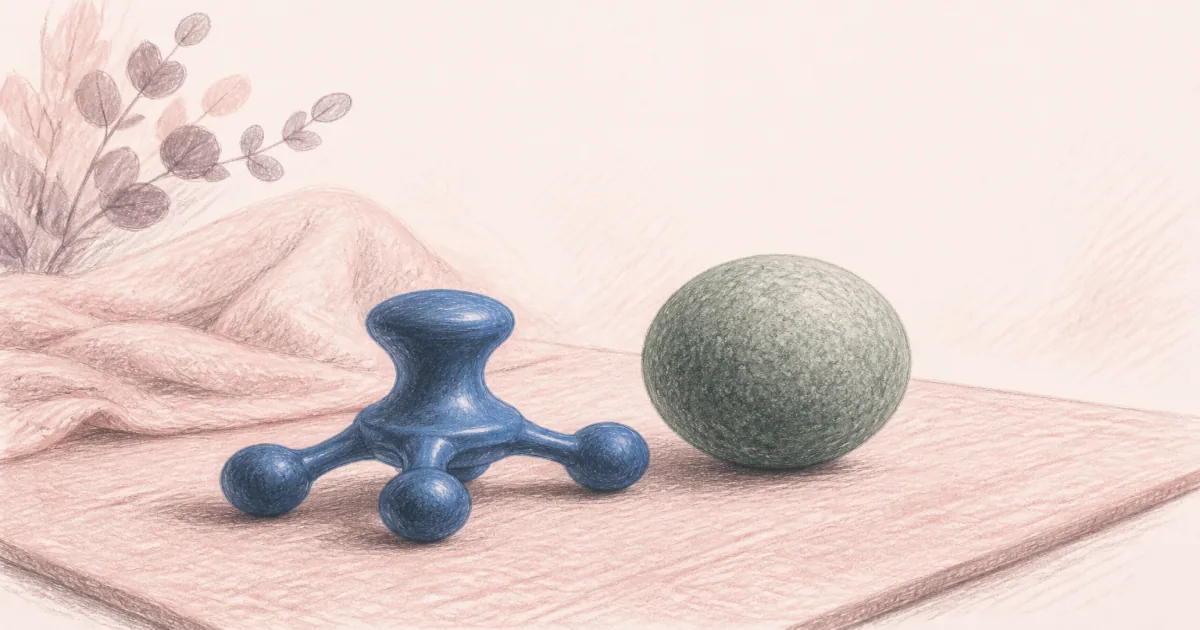
The Pressure Positive Knobble II is the tool most people should buy first. You cradle the rounded cap in your palm and use the tip (or the broader base) to press into a knot on the forearm, calf, hip, or upper back edge you can reach. It travels easily and does not need charging.
Start light. If the tissue softens a little and the local ache eases, that is enough. If you leave a bruise, you pressed too hard or too long.
Best for: desk drawers, travel pouches, and anyone whose thumbs tire quickly. Skip if: the knot sits where only a cane can reach.
Index Knobber II: handled precision
The Pressure Positive Index Knobber II is better when you want a clear handle and a focused tip. It shines on spots you can align with your hand without fighting awkward angles. Some people prefer it for partner work on reachable areas. It is less forgiving than Knobble when the angle is off, so keep sessions short while you learn the feel.
Best for: precise tip work and shared use with a partner. Skip if: you want one symmetric tool that works at odd angles without thinking.
TriggerPoint MB1: when a ball fits better
The TriggerPoint MB1 Massage Ball is the pick when you want body-weight pressure instead of hand pressure. Use it against a wall for the upper back edge, on the floor for glutes and hips, or under a foot for arch work. It overlaps with general massage balls, but the dense foam surface is a strong trigger-point style option in a bag-friendly size.
Best for: wall and floor loading, hips, glutes, and feet. Skip if: you need a palm tool for forearm or shoulder work while sitting at a desk.
Knob tool vs cane vs gun
Use this quick filter before you buy a second tool:
- Knob / Index Knobber: reachable knots, quiet pressure, thumb protection.
- Massage cane: mid-back reach behind the shoulder blades.
- Massage gun: fast broad coverage when noise is fine.
- Massage ball: body-weight spots against a wall or floor.
- Foam roller: large muscle groups that need sweeping coverage.
If you already own a cane and a gun, a Knobble still earns a place for small, precise spots those tools are clumsy at. If you own nothing yet and your main complaint is mid-back reach, buy the cane first.
How to use one without making things worse
- Find a tender spot that is muscle, not bone.
- Apply gentle pressure with the tool or ball.
- Breathe and keep tiny movements for 20 to 40 seconds.
- Recheck range or comfort, then move on.
- Stop if symptoms spread, numb out, or sharpen.
Pair these with a foam roller for larger areas and a massage cane only when reach is the blocker.
A useful home rule: if you cannot talk normally while pressing, the pressure is probably too aggressive. Ease off and try a neighboring spot rather than forcing the hottest point.
Common mistakes
Pressing on the spine or bony edges is the fastest way to make a useful tool feel like a bad idea. So is treating every sore spot as a trigger point that needs deep work. Some tissue wants movement, heat, or rest instead.
Another mistake is buying three tools that all do the same job. One palm knob plus one reach tool or one ball is usually enough for home recovery.
Care and travel
Wipe polymer tools with a damp cloth and dry them before they go back in a bag. Do not leave them in a hot car where soft grips can deform. The MB1 ball cleans easily and packs into a gym pouch without drama.
For flights, put small tools in a clear pouch so security can see them quickly. Leave the big cane at home unless you truly need mid-back reach on the trip.
Who should buy a different tool
Buy a massage cane for mid-back leverage. Buy a massage gun for fast, powered broad work. Buy a muscle roller stick for standing limb rolling. A tiny knob tool will not replace those jobs.
Buy nothing new if your current routine already keeps knots manageable and you are shopping out of curiosity rather than a real gap in the kit.
The bottom line
Make Knobble II your first trigger point massager unless you specifically want the handled Index Knobber II or a TriggerPoint MB1 ball for wall and floor work. Precise and gentle beats deep and dramatic.
Frequently Asked Questions
What is the best trigger point massager for most people?
The Pressure Positive Knobble II is the best default handheld tool. Choose the Index Knobber II for a handled tip, or the TriggerPoint MB1 when you prefer a ball against a wall or floor.
Is a trigger point massager the same as a massage cane?
No. A massage cane uses leverage to reach behind the shoulder blades. A trigger point massager in this guide is a small handheld or ball tool for spots you can reach or load with body weight.
How effective are massage sticks and knobs?
They work when you apply controlled pressure and keep the tool moving. They do not replace clinical care for unexplained pain, numbness, or weakness.
Should I buy a ball or a knob tool first?
Buy Knobble II if your knots are on areas you can reach with your hands. Buy a ball if you already like floor or wall rolling and want a smaller surface than a foam roller.
Can I use these on my neck?
Use light pressure only on soft tissue, never on the front of the neck or on bony edges. If neck symptoms radiate or worsen, stop and talk to a clinician.
How long should I hold a spot?
Usually 20 to 40 seconds of gentle pressure with slow movement is enough at home. Longer is not better if you bruise tissue.
Who should skip these tools?
Skip them over acute injury, clotting concerns when told to avoid pressure, open skin, or when a clinician restricted deep soft-tissue work.